▸ Reference reading. Texture, character, and a tee-up of how this campaign plays.
Mercer Falls in '96
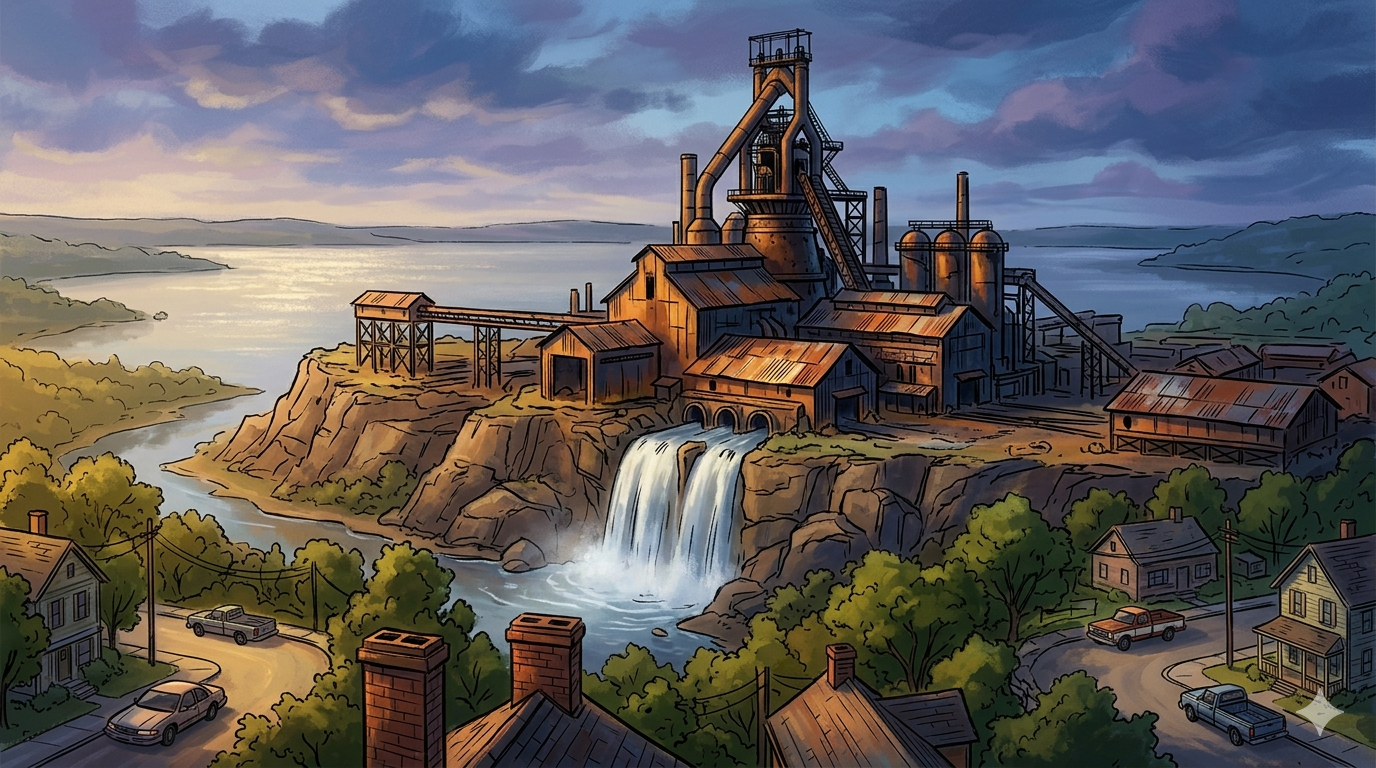
Mercer Falls is a small town figuring out how to survive without its main industry. The steel mill closed in '91 — almost nine hundred jobs gone in a single summer — and the place hasn't fully recovered. But the lake is still beautiful and the falls are still there, and the kids who didn't leave at eighteen have made their lives mostly work. The summers are pretty here. It's where you live.
Lately, the thing keeping the lights on is mainly tourism. The lake is beautiful and the falls are a real draw, and from Memorial Day through Labor Day the town has a different rhythm: visitors on the lake, families at the diner, license plates from Indiana and western New York and Michigan in the parking lots. The motels off Highway 21 fill up most weekends. The summer economy gets enough of a bounce to carry the town through the slow months. And boy, are there slow months. Once Labor Day passes, the visitors thin out, the lake quiets, and the town turns inward for the long Ohio winter. Mercer Falls is two different towns, depending on the season.
There's a quiet pattern about the visitors, too. Strangely few of them come back. They say they had a great time, send a postcard, mean to return, and they just…don't. Maybe Mercer Falls is one of those places you visit once. Most of the town stopped wondering about it a long time ago.
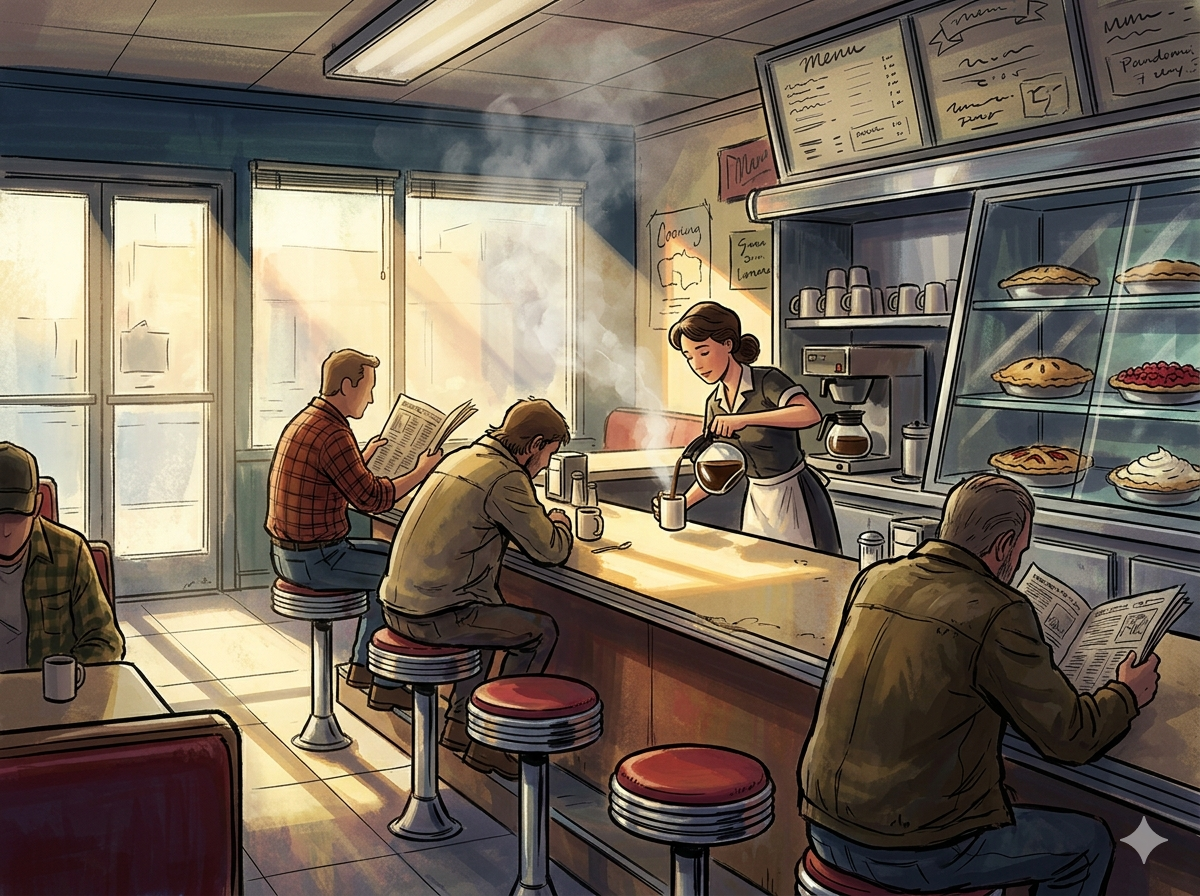
You've probably watched the town do its summer thing your whole life, or perhaps you're new here and learning what summer looks like in a place this size. Either way: it's June 1996. The mornings are humid. The cicadas haven't started yet but the kids on bikes have. The pool is open. The diner has the AC on. You're going to be playing a kid who lives here, and this guide is meant to give you a sense of the town — the geography, the people, the texture — so the place feels real when you start playing in it.
The campaign will be revealing this town to you slowly. Some places aren't on this guide because they haven't come up yet; some people aren't named here because you haven't met them. Mercer Falls will get bigger as you spend time in it.
The Town
Mercer Falls is built around its lake and its river. Both come into town from the north, both run through it, both shape what's where.
The Lake
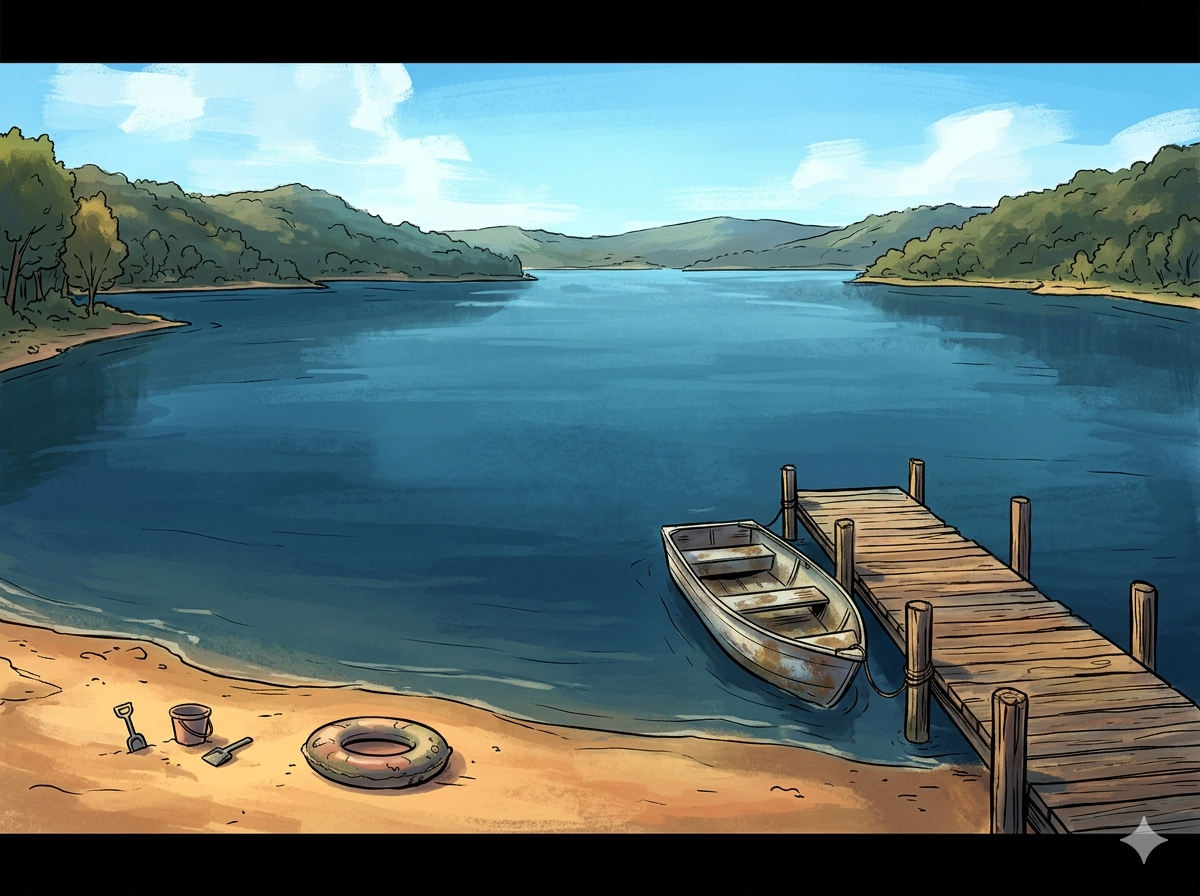
The lake is the town's true geographic anchor, even though most of daily life happens to the south of it. It's glacial — old, deep, holding a chill near the bottom even in August. A few public swimming beaches dot the shore; private docks claim the rest. Old families have boathouses with names painted on the eaves: Catherine M, Lakeview, Second Wind. The water is too cold to swim comfortably until July and then suddenly it's perfect.
In summer, the lake is the town's livelihood as much as its scenery. Pontoon rentals from a kiosk by the public beach at the southwest corner. Camp Mercer on the northwest shore taking kids in two-week sessions from May to August. The motels along Highway 21 to the north do most of their year's business between the holidays. Come Labor Day, all of that closes down or thins out, and the lake gets quiet again, and the town turns inward for a winter that lasts a long time.
The lake feeds the river. The river makes everything else.
The Mill and the Falls
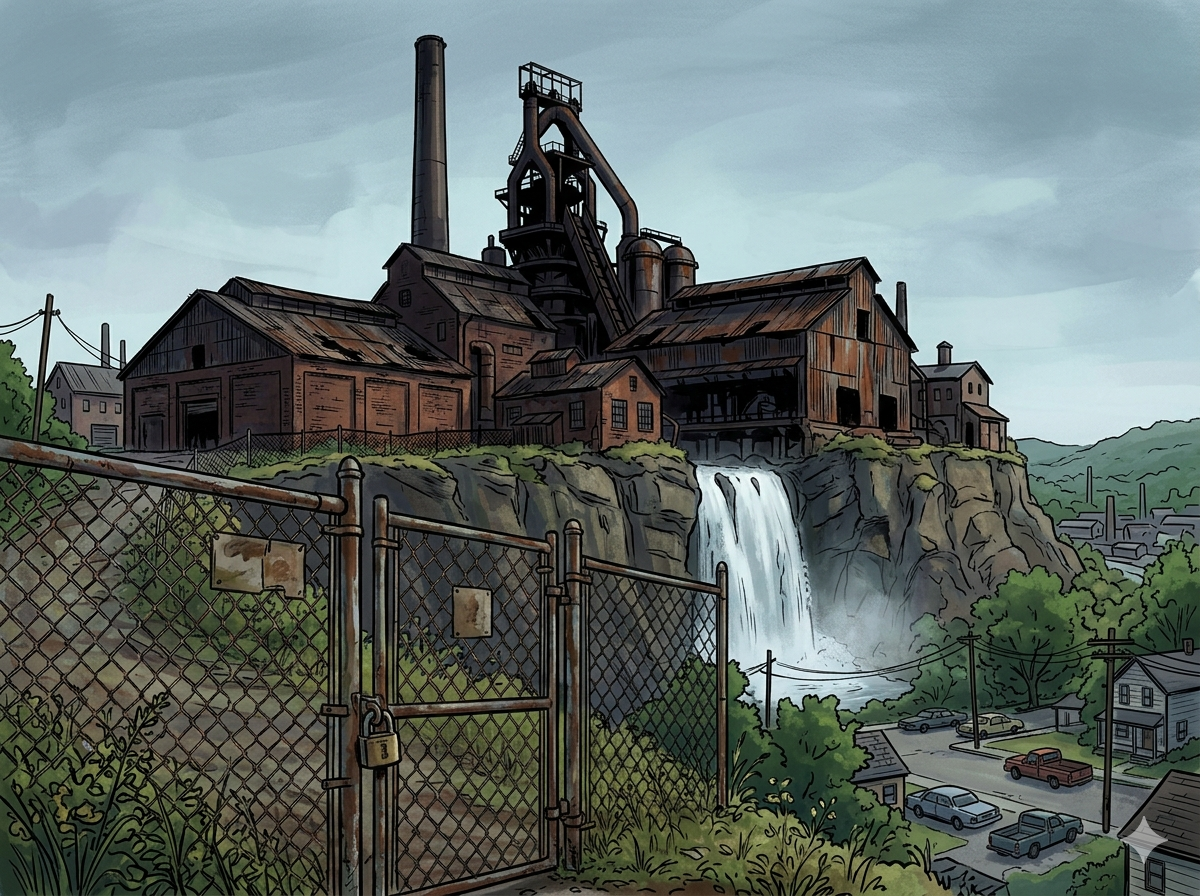
The mill sits at the geographic center of town, atop the bluff it was built around. The river runs into the mill from the north — coming down from the lake — and exits the south end as the falls. From the small overlook park west of the falls, looking up, you can see the water cascading down with the mill complex looming directly above and behind it, the blast furnace stack rising over the top edge of the cascade. From a distance, looking south at the right time of day, the mill appears to be the source of the falls.
The mill was the reason the town existed. It made structural steel for nearly a century and then it closed in '91, eight hundred and ninety-two people out of work over the course of a single summer (and that's just direct employees). The chain-link fence around the grounds went up that fall. The buildings are still there, slowly weathering — the blast furnace stack visible from anywhere in town, the long sheds with their rusted roofs collapsing inward, the loading docks where freight cars used to pull up.
People don't really walk around in there anymore. Kids who climb the fence get yelled at by the few adults who'd notice. There's something about the mill that the town doesn't quite want to look at directly. Most conversations about it stop after one or two sentences.
The falls themselves are fifty feet of water dropping over exposed bedrock, about eighty feet wide. They're a real draw. The overlook park has been there since mid-century — wooden bench, a 1950s interpretive sign about Elias Mercer and the founding of the town, a worn footpath descending toward the base of the falls that's closed off at the steep section by a rusted railing. People come, look, take pictures, leave. They look at the falls. They look past the mill.
Downtown
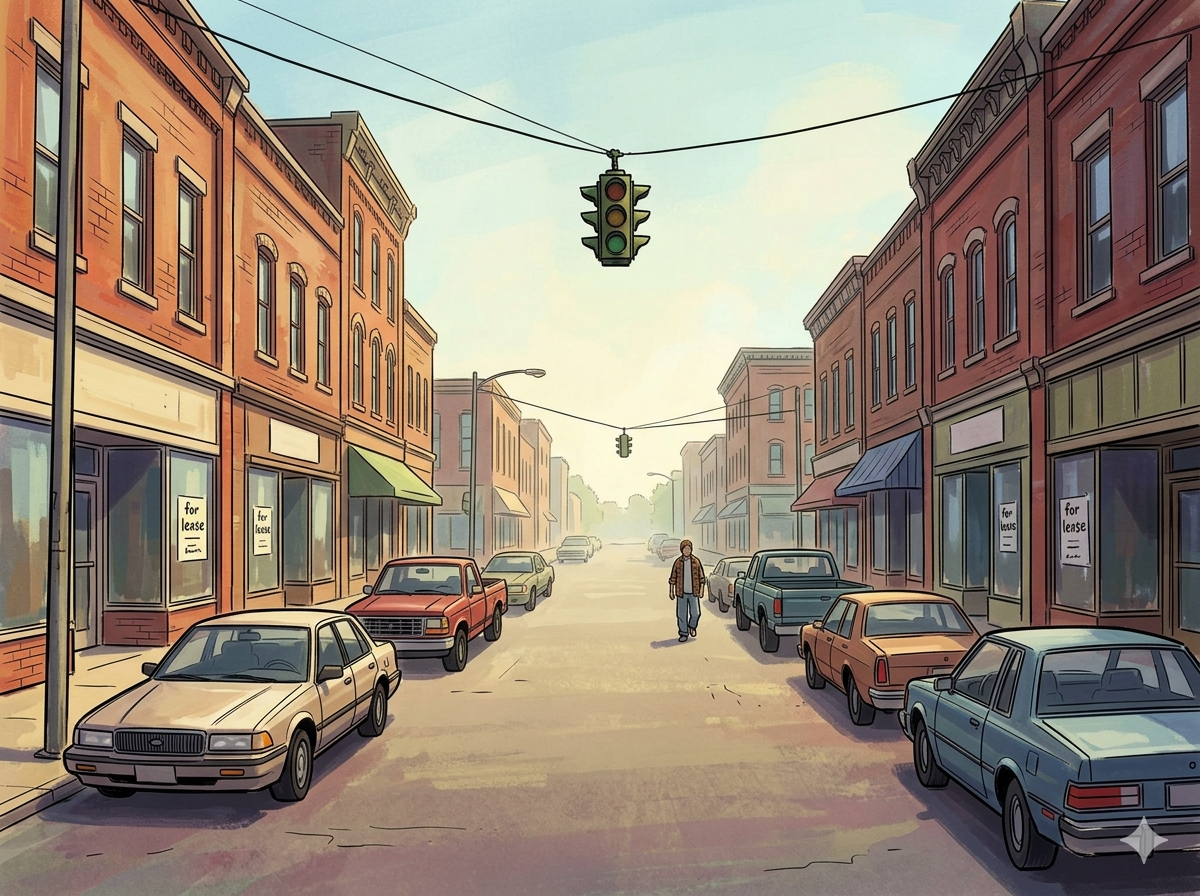
Main Street runs south from the mill bluff for about four blocks before it gets sleepy. Downtown is what you'd expect: a row of two-story brick storefronts, some of them filled, some of them holding for lease signs that have been there for two years. The river runs one block east of Main, with the institutional core (library, town hall, police, churches) clustered at the south end. Above many of the storefronts, apartments that have been there since the 1920s, with original tin ceilings and windows that don't quite close right anymore. Downtown is busiest on Saturday mornings and dead by 8 PM most weekdays.
There's a quality to downtown after dark on a weeknight where you can stand at the corner of Main and Walnut and hear nothing — no cars, no music, no people — for a full minute at a time. Other small towns have this. It's hard to describe to anyone who hasn't lived in one.
The Heights
Wrapping the lake's north and east shores, where the land rises into wooded hills above the water, is the Heights: where the old money lives. Big lawns, big trees, big houses set back from the road. The streets curve where they don't need to, because the planner who laid them out in 1903 liked them that way. Most of these families have been in town for three or four generations; some of the lakefront properties have private docks.
There's a curated quiet to the Heights; a silence that takes effort, like everyone has agreed to keep their volume down. Kids who grow up here don't usually skateboard. The houses look like they're listening to you when you walk past.
The Flats
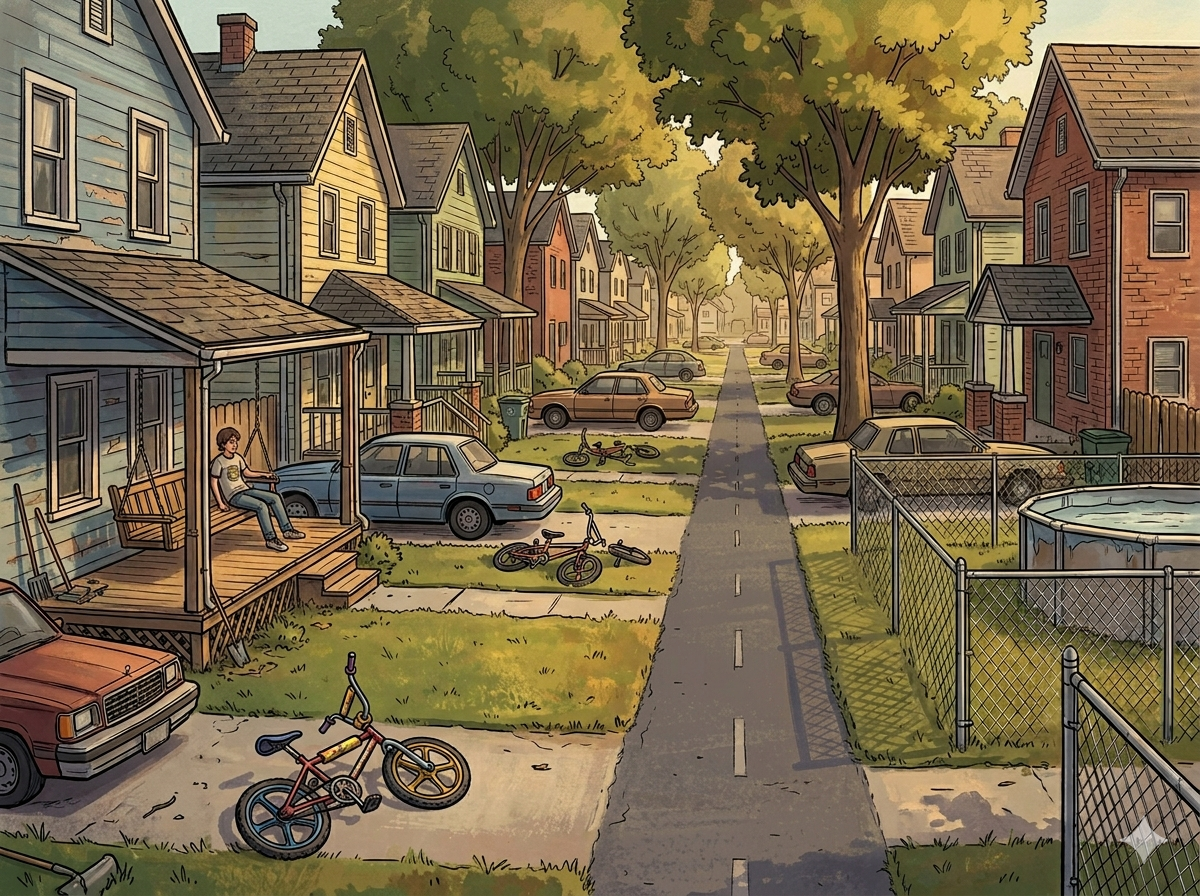
Wrapping the south and southeast shore of the lake and extending south along the river east of downtown is the Flats: working-class houses on smaller lots, mostly built between the '20s and the '50s, when the mill was hiring and people kept coming. Streets in grids. Kids' bikes left in driveways. Above-ground pools in maybe one in four backyards. Two duplexes for every single-family house. People here mostly know each other or know of each other. Family backyards back up to family backyards. There's always somebody on a porch.
The Flats are the closest thing the town has to a heart. If you grew up here, you have a hundred memories of running between yards, of being fed at neighbors' houses, of finding out from a kid on your block that something happened to somebody's dad. Things move here. Things land here. There's a density of life in the Flats you don't get in the Heights or in the newer subdivisions. The 1991 mill closure hit hardest here.
The South Side
Immediately east and south of downtown, on the gentle rise between Main Street and the cemetery, is the South Side: middle-class houses with two-car garages and finished basements. The school principal's family lives here. The doctor. The pharmacist. The owners of the diner. A couple of pastors. The kind of neighborhood where everybody knows where everybody works. Lawns are kept; driveways are filled with sensible American sedans; the porches are big enough for furniture you can actually use. People here are mostly doing fine. They go to high school football games together and have block parties on the Fourth of July.
Sycamore Subdivision
Southwest of downtown, across the railroad tracks, Sycamore Subdivision sprang up in '92 and '93 on what used to be farmland. About sixty identical houses, four floor plans, vinyl siding in four colors. The streets are named after trees that nobody planted enough of. Cookie-cutter is the word.
The kids here came from somewhere else — families that arrived after the mill closed, looking for cheaper places to land than the city they came from. Some are commuter families, with one parent driving an hour each way to a job in a bigger town. There's no history yet in Sycamore. Walking through the subdivision feels like walking through a place that hasn't decided what it is.
Out-in-the-County
Past the city limits, the roads narrow and the streetlights end. Farms. Some still working, some leasing their fields out to bigger operations. Stands of woods between the farms, some of them deeper than they look. The few houses out here are spread out — neighbors might be a half-mile away. Cell signal doesn't reliably reach (not that most people have cell phones in '96). The night sky is different out here.
The People
You can't really understand Mercer Falls without spending some time with the people who live here. This is a town where you'll have grown up around many of the same faces, where lives are visible in a way they aren't in bigger places. Some of the people you'll meet during the campaign you've already known for years, even if you've never really talked to them before.
Here are some of the people who inhabit Mercer Falls. None of these are necessarily important; they're just types of folks you've seen around.
Mrs. Brzezinski, who's been on Cedar Street since 1948. She sits on her front porch from after lunch until the streetlights come on, with a glass of iced tea sweating on the rail next to her. Knows every kid on the street by name and a lot of the kids on the next street over too. She'll wave at you if you're polite about it. She's been a widow for as long as you can remember.
The guy who pumps gas at the Sinclair, on the east side, by the lake road. You don't know his name even though you've seen him a hundred times. He's got a slow drawl, like a recording running at three-quarter speed. He can never quite remember which pump is which when you tell him. Friendly enough, in a vacant way. He's been there for years.
Mike Tinsmith, who keeps a fishing dock on the river a mile or two southeast of downtown. Fixes outboard motors for cash on the side; sometimes you'll see his old pickup parked down by the dock on a Saturday morning while he works on someone's engine. Salt-and-pepper beard, baseball cap, calloused hands. Friendly. Knows the water around here better than anyone in town.
Wesley Crane, who runs the community center downtown. Mid-thirties, the kind of guy who remembers your name after meeting you once. Hosts the grief support group on Wednesday evenings; runs the after-school program in the gym; organized the food drive last winter. There's usually a couple of teenagers helping him with something — sorting donations, setting up chairs, painting the back room. Talks to everyone.
Father Reilly, at St. Stephen's: the Catholic parish with the bell tower visible from anywhere on the east side. He's been there since you were small. Tall, and broad-shouldered but soft-spoken (outside of his sermons, anyway). Officiates the funerals when there are funerals. Knows everyone in his parish by face.
Mrs. Carney, the head librarian at the public library on Walnut. Lets kids stay past closing if they're working on something real. Knows where every book is without checking. Has cats; you can tell from the cat hair on her cardigan. Once helped your mom find an obscure book about something during a hard year, and your mom still talks about it.
Mr. Greaves, the old man who's lived on Cottonwood for as long as anyone can remember. Keeps to himself. His front yard has a garden that doesn't look quite like any other garden in town…things you can't identify, growing in patterns. His accent is unplaceable. He smiles at children but doesn't talk to them much.
And then there are the ones you can't quite pin down — the woman at the Kroger checkout who never quite looks you in the eye, the older guy who walks his dog past your house every evening at the same time without fail, the substitute teacher who covered Mr. Bennett's class for a week last spring and who you've never seen since. Mercer Falls has its types, and most people fit them. But not everyone does. Some people you can sense are somewhere else, even when they're standing right in front of you.
That's the texture of the town. You're not expected to remember names. The point is just that this is the kind of place Mercer Falls is — small enough that people are visible, big enough that not everybody knows everybody, slow enough that the same faces keep showing up.
How This Campaign Plays
This campaign uses standard D&D 5e rules. Anything in the PHB works the way the PHB says it does. However, there are three aspects of play that will use explicit game mechanics specific to this campaign — to match what the setting is and what the story cares about.
These mechanics get introduced gradually, taught at the table when they come up, and they'll feel natural pretty quickly. The point of mentioning them up front is not so you can study them; it's so you know what kind of game you're walking into.
Dungeons Are Encounters
The dungeons in this campaign are antagonists. They have agendas. They pay attention. They have moods that shift over time. Crossing one isn't a backdrop activity; it's a kind of encounter in itself.
To support that, time spent inside a dungeon runs on a system of dungeon turns — discrete units of in-fiction time, with specific things you can do during each one. Resources matter. Information has to be earned. You'll be making concrete choices about how to spend the party's attention, turn by turn.
This also means characters whose specialty is dungeon-craft — rogues with stealth and trap-finding, rangers reading the environment, the bookish character who notices the carving on the doorframe — have real scenes to do their thing in.
Your Time Is Real
You're playing a high school kid. You go to school. You have parents who expect you at dinner. You have chores, homework, a curfew. Your time is not entirely your own.
The free time you do have — the hours between school and dinner, the weekend mornings before your parents are up, the evenings when you're allowed out — is precious. The campaign treats it that way. There's a system for how you spend it.
Each day, you'll have a certain amount of free time as a resource — sometimes varying with the day, the season, or what's going on around you — and you'll spend that time on specific things you want to do. Following up on a hunch. Visiting a friend you're worried about. Swinging by a shop. Working on a project. Sitting at the diner watching who comes in. Each of those is a real choice that you make with your own time.
What this means is: school isn't a vague backdrop, it's a real claim on your day. The afternoon your dad asks you to mow the lawn is a real claim. And when you choose to go check on the kid who looked weird at school today, that's an active decision about what to do with what's yours.
This is also the system that supports Investigation-focused characters. Want your kid to be the one who pieces things together? You'll have the time, the methods, and the mechanical traction to actually do it.
Conversations Have Stakes
A lot of what this campaign cares about happens between people. Who you trust, who trusts you, who you're trying to convince, who you're trying to reach, what you say and what you don't. The story has people at its center — friends, family, the figures around town, the kid who might be in trouble. Conversations matter.
So for important social encounters — the ones where stakes are real and the NPC has reasons to seriously consider what you're saying — we'll use a structured system. Multiple turns. Multiple ways to engage. The chance to bring in what you've learned about the person you're talking to. The risk of saying the wrong thing and losing ground you took a long time to build. Some of these encounters will take as long as a fight does. Some of them will feel more important than a fight.
Low-stakes interactions still use the regular skill checks. The structured system kicks in only when the encounter deserves it.
If you want to play a social-focused character, this is your combat system. A character who's strong at reading people, building rapport, and finding the right pressure point pulls their weight at the table just as fully as a character who's strong with a sword. The face character carries real weight in certain scenes — not just color around someone else's tactical decisions. Wisdom/Insight-based characters get the same: figuring people out is a real capability in this campaign, not just an aside.
One More Thing
Remember, you're going to be playing a kid in this town. You may spend some of your time in places that aren't this town — the campaign has those places too, and we'll get there. But mostly, you'll be here. Mercer Falls in 1996, with the people who live in it and the lives they're living.
The campaign is going to ask things of your kid that they didn't sign up for. The world above ground is going to matter as much as anything underneath it. The choices you make about who to spend time with, who to listen to, what to follow up on, who to defend — these will be the choices that shape the story.
Bring a character you want to live with for a while.(I'll try not to kill 'em too quickly!)